

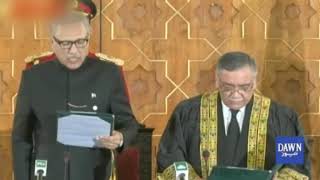
Justice Asif Saeed Khan Khosa took oath as the 26th Chief Justice of Pakistan at a ceremony at Aiwan-i-Sadr in Islamabad on Friday.
Chief justice Khosa will serve as top judge for approximately 337 days and is scheduled to retire on Dec 21, 2019.
President Arif Alvi administered oath to Justice Khosa before an audience of top government and military officials, Supreme Court judges, senior lawyers and dignitaries. “I will do right to all manner of people, according to law, without fear or favour,” said Justice Khosa.
Profile: Justice Asif Saeed Khan Khosa
Prime Minister Imran Khan, Chief of Army Staff Gen Qamar Javed Bajwa, Chief of the Air Staff Aasim Zaheer, Chief of Naval Staff Admiral Zafar Mahmood Abbasi, Senate Chairman Sadiq Sanjrani, National Assembly Speaker Asad Qaiser, Sindh Governor Imran Ismail, and members of the federal cabinet, all attended the ceremony.
A number of foreign dignitaries also took part in today's ceremony; Chief Justice of India Justice Ranjan Gogoi, President Supreme Court of the Turkish Republic of Northern Cyprus Narin Ferdi Sefik, Chief Judge State of Borno Nigeria Kashim Zannah, former senior puisne judge Supreme Court of India and President Governing Committee of the Commonwealth Judicial Education Institute Justice Madan Bhimarao Lokur, Savita Lokur (spouse), and Sandra E Oxner, former judge and founding president Commonwealth Judicial Education Institute, Canada.
The newly appointed chief justice afterwards reached the Supreme Court to assume charge of his duties. Upon arrival, he was presented guard of honour by a police contingent.
Justice Khosa has, over the course of his nearly two decade long career, decided about 55,000 cases. A special bench headed by him has decided over 10,000 cases of a criminal nature since 2014.
At outgoing chief justice Mian Saqib Nisar's full court reference on Thursday, Justice Khosa introduced the agenda for his tenure: "To attend to the causes that contribute towards delay in disposition of cases at all levels of the judicial hierarchy."
Read the full text of Justice Khosa's address here.
Justice Khosa had observed that there are 1.9 million cases pending before all courts across the country compared to just 3,000 judges and magistrates. "Successive governments have failed to suitably increase the number of Judges and Magistrates on account of financial constraints."
"It is, therefore, time to take some big and hard decisions," he had said, such as "structural and systemic changes so as to minimise litigation, eliminate unnecessary delays and rationalise the workload", and redesigning and restructuring of the judicial system as a whole.
Justice Khosa also called for open and free discussion on various issues and points of contention in order to "resolve such issues through a mutually agreed course of action".
"I am conscious that the issues being faced by the justice sector are gigantic but I may assure you that no stone shall be left unturned in attending to such issues and in trying to improve the situation. With Baloch blood running in my veins, I shall fight till the end and I am confident that with the support and cooperation of my colleagues and the Bar, the struggle shall bear fruit," he added.
Comments
Post a Comment