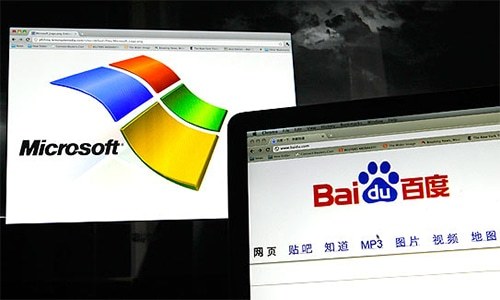
Microsoft's Bing search engine was inaccessible in China on Thursday, with social media users fearing it could be the latest foreign website to be blocked by censors.
Attempts to open cn.bing.com has resulted in an error message for users since Wednesday, taking away the most prominent foreign search engine available in China.
“We've confirmed that Bing is currently inaccessible in China and are engaged to determine next steps,” a Microsoft spokesperson said in a brief statement, hours after saying the company was investigating the matter.
China's Communist authorities operate an online censorship apparatus known as the “Great Firewall”, which blocks a slew of websites including Facebook, Twitter and several foreign media outlets.
But it was not clear whether or not Bing had joined the list of prohibited websites, or if its China service was experiencing technical difficulties. The search engine had been censoring searches in China.
The wording of the United States company's statement “means Microsoft received no government order, but clearly China has the power to block a URL and that may be what happened”, said independent US tech analyst Rob Enderle of Enderle Group.
“China has been aggressive in terms of controlling the media, 'censorship' is kind of their middle name. If there were searches going on providing results the Chinese government didn't like, it wouldn't surprise me if they blocked the site,” Enderle said.
But the analyst said it could also be a “hack gone wrong”.
China's cyberspace administration did not immediately return a request for comment.
Walled off
China's Great Firewall can be circumvented by using a virtual private network (VPN), which can hide a user's IP address.
While its rival Google shut down its search engine in China in 2010 after rows over censorship and hacking, Bing has continued to operate in the country along with Microsoft-owned Skype.
On Weibo, China's Twitter-like social media site, people complained about the lack of access, with some speculating that Bing too had been “walled off”.
Others aired their dissatisfaction about having to use Baidu, China's largest domestic search service.
"Even Bing requires a VPN now, how exhausting," wrote one user.
"Our country is amazing, even the obedient Bing has been walled off, while Baidu flourishes," said another. “Thank you wise party leaders!”
'Tit-for-tat'
China has tightened policing of the internet in recent years, shuttering 26,000 "illegal" websites in 2018 alone and deleting six million online posts containing vulgar content, the official Xinhua news agency said earlier this month.
Bing complies with Chinese censorship rules, but its link to US tech giant Microsoft might have put it in the government's crosshairs as Beijing and Washington spar over trade and tech issues.
"The fact that Bing is run by Microsoft, which is not a Chinese company, means that Beijing has less leverage over the company, compared to, say Baidu," said Lokman Tsui, an assistant professor at the Chinese University of Hong Kong.
The block is also “mostly symbolic,” given Bing's tiny market share in China, he told AFP.
Tsui also noted that there is growing concern over China's slowing economy, and that June will see the highly sensitive 30th anniversary of the violent suppression of democracy protests in Tiananmen in 1989.
"Beijing needs to look like they are in charge and in power," he said.
The US and China are locked in a bruising trade war, with the former's accusations that Beijing steals technological know-how among the core disagreements.
Washington has also led efforts to blacklist Chinese telecoms giant Huawei internationally over security concerns, and one of the company's top executives, Meng Wanzhou, was arrested in Canada last month over fraud allegations on a US request.
The two sides are scheduled for new trade negotiations next week.
"Given Washington's bid to contain Huawei, China is sharpening its moves against the American tech industry, especially those affiliated with Silicon Valley," Tom Fowdy, an independent Beijing-based political analyst, told AFP.
"So in some ways, it could be tit-for-tat," he added. "'You contain our leading technology and software companies, we will contain yours'."
Comments
Post a Comment