India court orders security for women who entered flashpoint temple


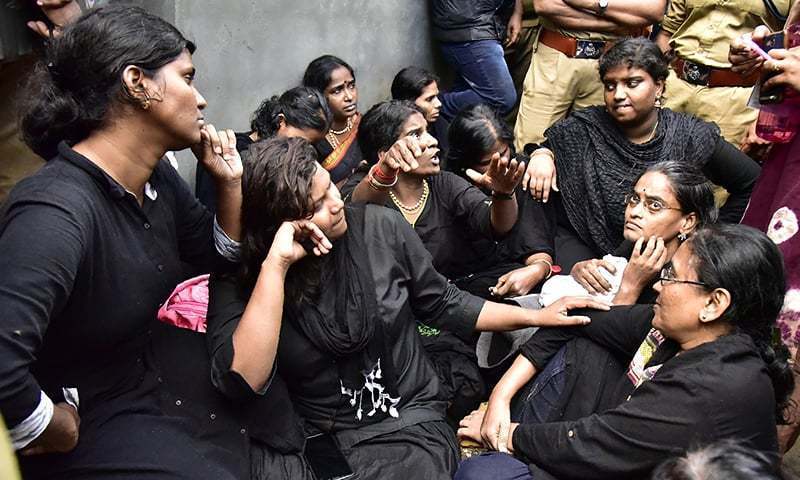
India women activists from a 'Manithi' NGO gesture as they had arrive to start their treck to Sabarimala Ayyappa temple.—AFP/File

The Indian Supreme Court on Friday ordered southern Kerala state to provide “round-the-clock” security to two women who enraged conservatives by entering one of Hinduism's holiest temples earlier this month.
The court had overturned a ban in September on women aged between 10 and 50 from entering the hilltop Sabarimala temple, but the devotees refused to accept the ruling and prevented female worshippers from entering.
News that two women had managed to enter the shrine on January 2 triggered days of violent protest, with one person killed and dozens injured in clashes with police that saw buses torched and bombs hurled.
The women, Bindu Ammini and Kanakadurga, went in hiding and later approached the top court, claiming their lives were in danger.
“Having heard the lawyers we deem it appropriate to close this petition at this stage by directing Kerala to provide adequate security to both. The security will be provided round the clock,” the court said.
Kanakadurga, who goes by one name, was allegedly attacked by her mother-in-law on Tuesday after returning home and was admitted to a hospital for her injuries.
She had been on the run for days with Ammini, with the pair changing safe houses more than 10 times to avoid being tracked down.
The temple — considered among the holiest in Hinduism and set on top of a hill in a tiger reserve — receives millions of pilgrims a year.
It is dedicated to the celibate deity Ayyappa, and followers believe letting in women of menstruating age goes against his wishes. It is one of the few Hindu temples with restrictions on the entry of women.
The Indian apex court is expected to hear legal challenges to its September order overturning the ban on women entering Sabarimala next week.

Comments

Popular posts from this blog

Sarfraz apologises for 'black guy' comment

"My words were not directed towards anyone in particular and I certainly had no intention of upsetting anyone," says Sarfraz Ahmed. Pak­is­tan captain Sarfraz Ahmed apologised on Wednesday following a controversial comment aimed at South Africa’s Andile Phehlukwayo which was picked up by a stump microphone during the second one-day international in Durban on Tuesday. The incident occurred in the 37th over of South Africa’s run-chase during the game at Kingsmead when Phehlukwayo got an inside edge off a Shaheen Shah Afridi delivery that narrowly missed the stumps. As Phehlukwayo, who was on 50 at the time, ran to the non-striker’s end, Sarfraz was heard on the stump microphone saying in Urdu:  "Abey kaale, teri ammi aaj kahaan baitheen hain? Kya parwa ke aaye hai aaj?" When translated into English that means: "Hey black guy, where’s your mother sitting today? What [prayer] have you got her to say for you today?" The skipper tweeted...

Justice Asif Saeed Khosa sworn in as 26th Chief Justice of Pakistan

Prime Minister Imran Khan (L), President Arif Alvi (C) and Justice Asif Saeed Khan Khosa (R) at the oath-taking ceremony at Aiwan-i-Sadr. ─ Photo courtesy Imran Khan Instagram Prime Minister Imran Khan (L), President Arif Alvi (C) and Justice Asif Saeed Khan Khosa (R) at the oath-taking ceremony at Aiwan-i-Sadr. ─ Photo courtesy Government of Pakistan Twitter Prime Minister Imran Khan (L), President Arif Alvi (C) and Justice Asif Saeed Khan Khosa (R) at the oath-taking ceremony at Aiwan-i-Sadr. ─ Photo courtesy Imran Khan Instagram Justice Asif Saeed Khan Khosa took oath as the 26th Chief Justice of Pakistan at a ceremony at Aiwan-i-Sadr in Islamabad on Friday. Chief justice Khosa will serve as top judge for approximately 337 days and is scheduled to retire on Dec 21, 2019. President Arif Alvi administered oath to Justice Khosa before an audience of top government and military officials, Supreme Court judges, senior lawyers and dignitari...

Experts, images suggest a Saudi ballistic missile programme is in the works

Question remains where Saudi Arabia gained the technical know-how to build such a facility.  A military base deep inside Saudi Arabia appears to be testing and possibly manufacturing ballistic missiles, experts and satellite images suggest, evidence of the type of weapons programme it has long criticised its arch-rival Iran for possessing. Further raising the stakes for any such programme are comments by Saudi Arabia's powerful Crown Prince Mohammed bin Salman, who said last year that the  kingdom wouldn't hesitate to develop nuclear weapons  if Iran does. Ballistic missiles can carry nuclear warheads to targets thousands of kilometres away. Officials in Riyadh and the Saudi Embassy in Washington did not respond to requests for comment. Having such a programme could further strain relations with the United States, the kingdom's longtime security partner, at a time when ties already are being tested by the  killing of  Washington Post ...