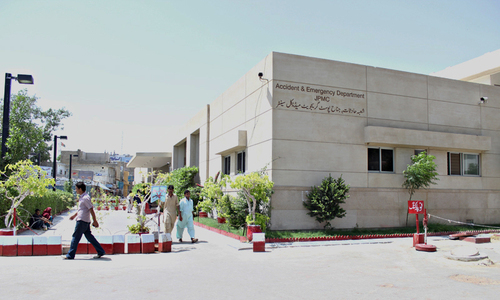
Ownership of Karachi's JPMC, NICVD, NICH to remain with federal govt, SC rules


The court in its verdict rejected the Sindh government's request and said that control of all three hospitals will remain with the Centre. —Dawn archives

The Supreme Court on Wednesday rejected the Sindh government's request for ownership of three major Karachi hospitals, and wrapped up a dispute between the provincial government and the Centre over the control of the hospitals.
The Sindh government had approached the Supreme Court with the claim that since the subject of health had been devolved to provinces under the 18th Amendment, the management of the hospitals ─ namely the Jinnah Postgraduate Medical College (JPMC), National Institute of Cardio Vascular Diseases (NICVD) and National Institute of Child Health (NICH) ─ should rest with it.
A five-member bench headed by the chief justice had taken up a set of appeals by the Sindh government against the July 4, 2016 verdict of the Sindh High Court, declaring that these institutions fell within the scope of the Entry 16 of the federal legislative list and, therefore, within the exclusive federal domain.
Chief Justice Saqib Nisar who was heading the three-member bench hearing the case read out the verdict in court today. The reasons behind the ruling would be listed in a detailed judgement later.
The court in its verdict rejected the Sindh government's request and said that control of all three hospitals will remain with the Centre.

Comments

Popular posts from this blog

Sarfraz apologises for 'black guy' comment

"My words were not directed towards anyone in particular and I certainly had no intention of upsetting anyone," says Sarfraz Ahmed. Pak­is­tan captain Sarfraz Ahmed apologised on Wednesday following a controversial comment aimed at South Africa’s Andile Phehlukwayo which was picked up by a stump microphone during the second one-day international in Durban on Tuesday. The incident occurred in the 37th over of South Africa’s run-chase during the game at Kingsmead when Phehlukwayo got an inside edge off a Shaheen Shah Afridi delivery that narrowly missed the stumps. As Phehlukwayo, who was on 50 at the time, ran to the non-striker’s end, Sarfraz was heard on the stump microphone saying in Urdu:  "Abey kaale, teri ammi aaj kahaan baitheen hain? Kya parwa ke aaye hai aaj?" When translated into English that means: "Hey black guy, where’s your mother sitting today? What [prayer] have you got her to say for you today?" The skipper tweeted...

Two youths killed by Indian forces in occupied Kashmir

Indian government has deployed forces across occupied Kashmir as residents observe Black Day.  Indian troops killed two Kashmiri youths in the Khonmoh area of Srinagar, Kashmir Media Service (KMS) said on Saturday. Clashes between Indian police and residents of the area erupted in the aftermath of the killings, when Indian police used force to disperse demonstrators who had come out on the streets to protest. The killings took place on India's Republic Day, which is observed as Black Day by residents of Indian-occupied Kashmir and Azad Jammu and Kashmir. The call to observe India's Republic Day as Black Day was given by the Joint Resistance Leadership (JRL), that is led by Syed Ali Gillani, Mirwaiz Umar Farooq and Mohammad Yasin Malik, the KMS said. The JRL leaders said in a statement that India had "no justification" to observe Republic Day in held Kashmir as the territory had been "illegally occupied" against the wishes of Kashmiri ...

Shared heritage

IF you have heard the qawwali Kangna by Farid Ayaz and Abu Muhammad, it is impossible not to notice a Persian interlude which goes: “Ma ra ba ghamza kusht o qaza ra bahana sakht” (Am struck by the beloved’s coquettish ways; death is but an excuse) The famous ghazal was penned by the 12th-century poet Nizami Ganjavi. It has been sung by dozens if not hundreds of singers wherever Persian is understood including by Iqbal Bano in our neck of the woods. Nizami’s birthplace Ganja was part of the Persian Empire back then and came under Russian control half a millennia later. Though the Republic of Azerbaijan was proclaimed only in 1918 this did not deter the Azeris from embracing and celebrating him by establishing the Nizami Museum of Literature in Baku, the country’s capital and putting his picture on a currency note of 500 manat, among myriad other commemorative initiatives. Nazrul Islam, Gul Khan Naseer, Ameer Hamza Shinwari, Shaikh Ayaz, Nasir Kazmi, Ahmad Faraz, If...